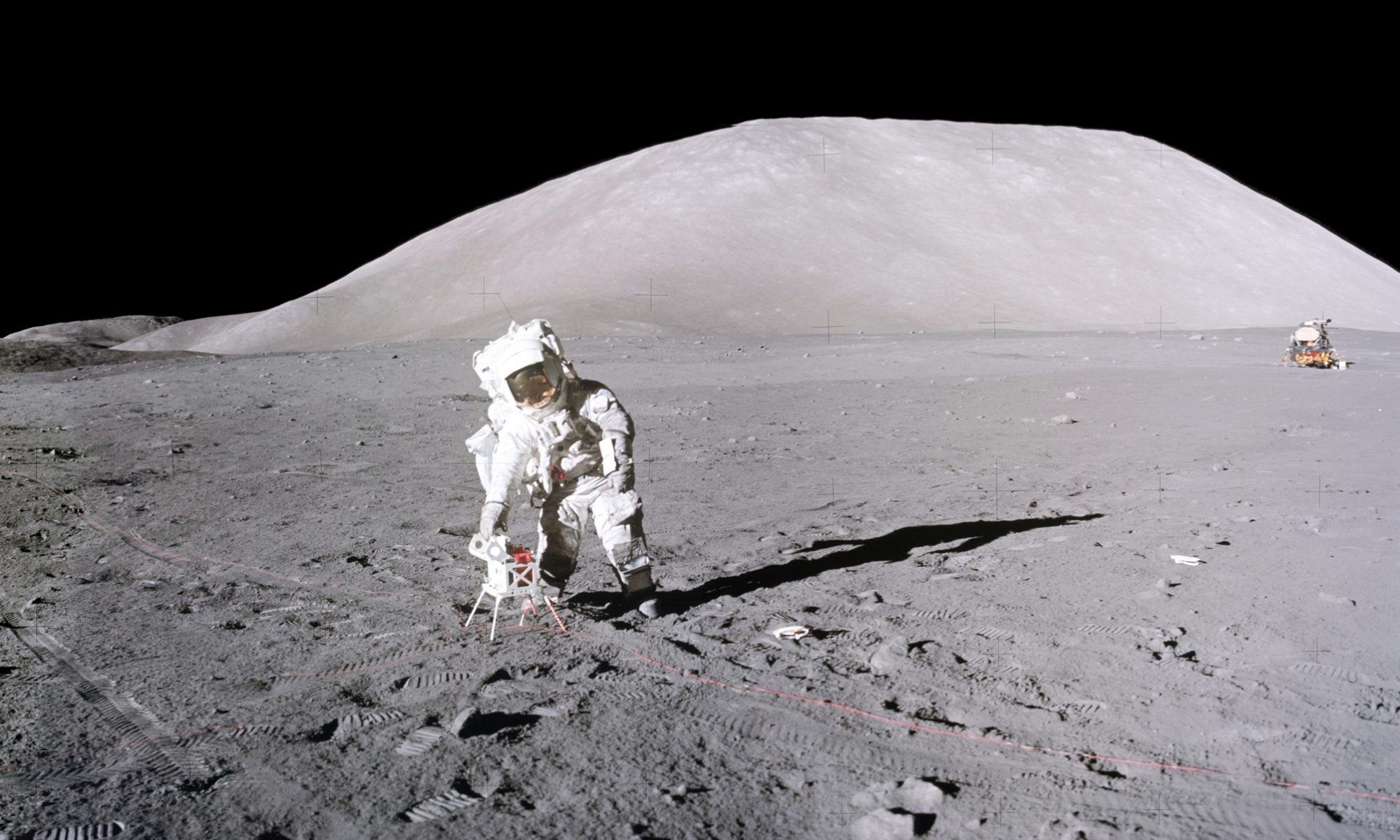
History in the Dust
This chapter chronicles the technical analyses and interpretations, both geochemical and geological, by Dr. Harrison H. Schmitt of the observations and samples from the surface of Taurus-Littrow obtained during the three days he spent on the Moon in December, 1972 as a member of the Apollo 17 crew.
A reminder to readers: in the main text linked in the below sections, there are five types of links—one each for Fig. nos., Table nos.; author citations (by year of publication); section nos.; and DOI, World catalog, or other journal type links in the Endnotes. All links are blue-underlined. For the first 3 types, when the reader clicks on the link and goes to the item, return to the reading place is effected by clicking on the back-arrow at the top left corner of the WordPress display. However, for section nos. (preceded by §) and for journal citations in the Endnotes, the links open in an upper, separate tab(window). When finished perusing the section no. or the journal abstract, the original reading place is in the original window(tab). The separately opened tab(window) can be closed when the reader is finished to avoid accumulating many open tabs(windows) across the display screen. Small up or down arrows at the end of Fig. or Table no. links remind the reader that the given item is located earlier or later in text. If a Fig. or Table number citation in text is close to the item itself, there is no need for a link.
Table of Contents
Section 1:
The Regolith of Taurus-Littrow: Strata, Source Craters, Ages and Implications
Summary of the 13 major findings resulting from the synthesis of data related to the observations and samples of regolith in the valley of Taurus-Littrow.
General review of the sources of data related to this synthesis.
1.1 General Nature of Lunar Regolith
2.0 Error Limits Related to Taurus-Littrow Data Synthesis
Definition and analysis of the 11 regolith ejecta zones (strata) in the 2.85 m long deep drill core and their source impact craters based on half-cm log of the core and ejecta zone lithologies.
3.2 Deep Drill Core Maturity Indices and Regolith Ejecta Zones
3.2.1 Agglutinate Formation in Relation to Is/FeO Maturity Index
3.3 Regolith Transport After Large Impacts in Lunar Gravity and Vacuum
3.4 Source Craters for Regolith Ejecta in Deep Drill Core
3.4.1 Lara Crater as Possible Source Crater
3.4.2 Possible Source Craters on the Massifs
3.4.3 Reach of Each Source Crater’s Regolith Ejecta
4.0 Process Sequence that Forms Inter-Crater Regolith
Details on the processes that formed the Taurus-Littrow regolith, including partial reset of Is/FeO values by impact shock and heat, as represented in the deep drill core and other Taurus-Littrow regolith samples.
4.2 Impact Shock Partial Resets of Is/FeO Values
4.3 Summary of Detailed Is/FeO Log of Apollo 17 Deep Drill Core
5.0 Petrography and Composition of Deep Drill Core Regolith Zones
Detailed compositional modeling of the regolith ejecta zones in the deep drill core in relation to the geological context and nature of regolith at the site of a zone’s source crater.
5.2 Compositional Modeling of Source Regolith for Deep Drill Core Regolith Ejecta Zones
6.0 ΔIs/FeO-Based Ages of Source Crater Impacts and Zone Deposition
Calculation of ∆Is/FeO / Myr values for alpha+beta and solar proton additions to regolith Is/FeO and preliminary ∆Is/FeO-based exposure age dating of the source craters related to each regolith ejecta zone in the deep drill core, including an analysis of related nitrogen isotopic fractionation data.
6.2 Nitrogen Isotopic Ratios in the Deep Drill Core
6.2.2 Detailed Relationships Between ∆Is/FeO and δ15N‰ in the Deep Drill Core
6.2.3 Second Change in the Energy of the Solar Wind Late in Lunar History
6.3 Solar Proton and Uranium+Thorium Alpha+Beta Decay Particles Contributions to ∆Is/FeO / Myr
6.3.2 Alpha+Beta-only ∆Is/FeO / Myr
6.3.3 Solar Proton-only ∆Is/FeO / Myr
6.3.4 Regolith Particle Patinas Possible Role in Attenuation of Proton-only ∆Is/FeO
6.4 ∆Is/FeO Derived Exposure and Deposition Ages for Deep Drill Core Zones
6.4.2 Evaluation of Deep Drill Core Cosmic Ray Exposure Ages
6.4.4 Depth Corrections for Post-Burial Additions to Apparent Cosmic Ray Exposure Ages
7.0 Ilmenite and Volcanic Ash Attenuation of Nano-Phase Iron Formation During Regolith Maturation
Final ∆Is/FeO-based exposure age dating of the source craters related to each regolith ejecta zone in the deep drill core, as adjusted for Is/FeO attenuation by volcanic glass and ilmenite.
7.2 Ilmenite Attenuation of Nano-Phase Iron Formation
7.3 Pyroclastic Ash Attenuation of Nano-Phase Iron Formation and Corrected Deep Drill Core Ages
Analysis of the contrast between ∆Is/FeO-based exposure ages and cosmic ray exposure values.
9.1 Rate of Impact Is/FeO Resets
9.2 Apollo 17 Neutron Probe Stratigraphic Interpretation of Deep Drill Core
10.0 Geology and Maturation of Orange+Black Ash at Shorty Crater
Detailed synthesis of observations and data related to the orange+black ash at Shorty Crater, in particular, as related to the core 74001/2 from this nearly pristine pyroclastic ash deposit.
10.1 Geological Context of the Orange+Black Ash Deposit
10.2 Regolith Development on Ash Deposits
10.3 Deposition Ages of Orange+Black Ash Deposit
10.4 Pyroclastic Record of the Decline of the Ancient Lunar Magnetic Field
10.5 Primordial δ15N‰ for the Moon
10.6 Very Low Titanium (VLT) Ash Eruptions
Geology and implications of the light gray regolith ejecta deposit that protected the orange+black ash in situ for ~3.5 billion years.
11.2 Inconsistency Between Cosmic Ray Ages and Is/FeO Values
13.0 Solar and Lunar History in Regolith and Regolith Breccias at Van Serg Crater
13.2 Regolith Ejecta Sequence at Van Serg Crater and its Correlation with Deep Drill Core Zones
13.3 Deposition Age Estimates for Regoiith Ejecta Zones Sampled at Van Serg Crater
13.4 Solar History in Nitrogen Isotopes at Van Serg Crater
14.0 Nitrogen Isotopes Implications Relative to Solar History
Implications of variations in the values of δ15N‰ (14N/15N ratio) as related to the composition of the solar wind over time.
15.0 Source Crater Ages Versus Diameter to Depth Ratios
17.0 Geology of the Light Mantle Avalanche Deposits
Analysis of the geology and ages of three South Massif avalanche deposits that make up the light mantle unit in Taurus-Littrow.
17.3 Light Mantle Avalanche Dynamics
17.4 Deposition Age of the Young Light Mantle
17.5 Stratigraphy of Light Mantles in Core 73001/2
17.6 Stratigraphic Data in Core 73001/2
17.7 Deposition Age of the Old Light Mantle
17.8 Age of the Ancient Light Mantle Avalanche
17.9 Summary of the Detailed Is/FeO Log of Double Drive Tube Core 73001/2
17.10 Regolith Accumulation on the South Massif Slope
17.11 Basaltic Regolith and Pyroclastic Ash Ejecta Deposition on the South Massif Slope
17.12 Relationships of Station 3 Trench Samples to Core 73001/2
17.13 Lee-Lincoln Thrust Fault Activity Triggers for Light Mantle Avalanches
18.0 Thermoluminescence of Taurus-Littrow Regolith
Geological interpretations of thermoluminescence values in Station 6 regolith and the deep drill core.
18.2 Continuously Shaded Regolith Sample 76240
18.3 Periodically Shaded Regolith Samples 72220 and 72320
18.4 Buried Zones in the Deep Drill Core
19.0 Regolith Core 76001 from North Massif Station 6
Geological history of North Massif slope regolith.
19.2 Petrographic, Petrological and Maturation Variables in Core 76001
19.3 Exposure Age Considerations Related to Core 76001
20.0 Orange+Black and VLT Ash Distribution in North Massif Slope Regolith
21.0 Boulder Tracks in Massif Regolith
21.2 Longevity of Massif Boulder Tracks
22.0 Age of Imbrium Basin-Forming Impact Between 3.850 and 3.795 Ga
23.0 Dark Mantle Dilution of Light Mantle Regolith
24.0 ∆Is/FeO / Myr Considerations Related to Station 1 Samples
25.0 Lithoclastic Debris Erupted Prior to Basalt Eruption
Evidence for pre-mare basalt eruption of lithoclastic debris due to release of volatiles as heat accumulation in the upper mantle approached partial melting.
25.2 Presence of Lithoclastic Debris in North Massif Slope Regolith
26.0 Volatile Concentrations in Bulk Regolith vs. Regolith Breccias
27.0 Symplectites in Dunite 72415 and Troctolite 76535
Pressure release origin for symplectites, as evidence for a Procellarum basin-forming impact at ~4.35 Ga.
27.2 Lunar Symplectite Petrogenesis
27.3 Norwegian Basal Gneiss Region Symplectite Analogs
27.4 Procellarum Basin-forming Impact
28.0 Fractional Crystallization of Station 1 Ilmenite Basalt
29.0 Conclusion of the Taurus-Littrow Synthesis
Regolith Ejecta Excavation and Transport
Post-Deposition Modification of Regolith Ejecta Zones
Geological Sources of Regolith Ejecta Zones
Maturity Index (Is/FeO)-Based Exposure Ages
Evaluation of Cosmic Ray Exposure Ages
Thickness of Taurus-Littrow Valley Regolith
Ilmenite Basalt and Orange+Black Pyroclastic Ash
Light Gray Regolith Covering Pyroclastic Ash
Thermoluminescence of Taurus-Littrow Regolith
Pre-Basalt Lithoclastic Debris
Procellarum Impact Induced Overturn
Fractional Crystallization of Ilmenite Basalt Lava
Section 1: ENDNOTES
−−−−−−−−−−−−−−−−−−−−−−−−−−−−
Section 2
Origin of Life
Potential catalytic role of phyllosilicates in pre-biotic organic synthesis
(Adapted and updated from Schmitt, 2015)
5.0 Earth’s Surface Temperature
7.0 Phyllosilicates’ Potential Pre-Biotic Role
8.0 Genesis of The First Pre-Biotic Macromolecules
8.1 Indigenous Pre-Biotic Chemicals
8.2 Exogenously Introduced Pre-Biotic Chemicals
9.0 Phyllosilicates as Catalysts
Section 2: ENDNOTES
Copyright © by Harrison H. Schmitt, 2026. All rights reserved.